
Information Technologies in Business
Dean of Information Technologies in Business Faculty
Professor
Khabarov Valery
Dean's office: cab. 462a
Contact phone: 328-03-76.
E-mail: fbi@stu.ru
Mission of the Information Technologies in Business Faculty
• Teaching of specialists in the field of information support of business processes, corporate information systems, intelligent transport systems, transport and logistics processes
• Conversion Degree of specialists in a situation that requires increasing the pace of business processes and high quality logistics
• Conversion Degree of specialists with higher education in the field of information support of business processes and corporate information systems for railway transport of Russia, logistics and supply chain management
• Conversion Degree of scientific and teaching staff of higher qualification in postgraduate and doctoral studies
• Performing R&D in the field of IT-technologies in transport, management of organizational-technical and economic systems
• Consolidation of research in the field of business Informatics at the University together with Russian Railways company
The faculty of «Information Technologies in Business Faculty» - the Applicant
Short information about the directions and entrance tests You can find by downloading the booklet IT in Business Faculty
What is "Information Technologies in Business"? Business is translated as "Deal". So business Informatics is business deal or Applied Information Science. This term is already generally accepted and is associated with activities in the field of corporate information systems, the same as large software systems that support the activities of enterprises, firms, business structures.
Since the STU is industry-specific University, and prepare are specialists for rail transport, it is clear that the subject focus of training in information technology related to transport. Studying programming languages, network technologies, databases, intelligent information systems, Web-technologies, business process modeling and many other things at our faculty in specialized laboratories. You will have an opportunity to apply these technologies to solve specific problems. This is the best way to learn anything. Here are a few of the real names of the graduation projects done by the graduates of our faculty:
• Creation of a functioning computer model of a cargo station with elements of artificial intelligence.
• 3D simulation railways stations.
• Development of the basic business process model of the freight and commercial service under the RUP methodology.
Modeling business processes of budgeting of the organization using the ARIS methodology.
• Creation of a specialized information portal for the prevention and elimination of emergencies in the transport of dangerous goods.
• Intelligent monitoring systems based on wireless peer-to-peer networks.
• Content management systems IN web portals based on Xaraya, SharePoint.
Your opportunities:
The choice of individual educational pathways, the implementation of its main project — higher education.
Field training and employment at the leading companies of Novosibirsk and other regions of Russia and abroad.
The opportunity to participate in real transports, logistics and IT projects.
Learning programming languages C++, Java, C#, Prolog, PHP, SQL, Object Pascal.
Obtaining skills of working with specialized software in the field of logistics.
Designing mobile applications on the platform of Android, iOS, Windows.
Employer-sponsored education.
Participation in activities of the Siberian transport University: freshman day, Trade Union Community, creative initiative, sport events and etc.
Directions and profiles offered by our faculty:
BACHELOR DEGREE
09.03.02 "Information systems and technologies" profile: Intelligent transport systems.
Entrance exams: College Mathematics, Russian language, Informatics
The field of professional activity of graduates: research, development, implementation, maintenance of information technologies and systems (including transport). Form and duration of training: full — time-4 years.
The number of scholarships and commercials places for the 2017-18 academic year
| Code | Direction of education | Scholarships places for 2018 | Commercial places for 2018 |
| 09.03.02 | "Information systems and technologies" profile: Intelligent transport systems. | 25 | 25 |
09.03.03 "Applied Informatics". Profile: Corporate transport systems.
Entrance exams: College Mathematics, Russian language, Informatics
The field of professional activity of graduates: system analysis of the applied field, development of projects of automation and IT development of applied processes and creation of information systems, development and implementation of corporate information systems (including transport). Form and duration of education: full — time — 4 years; part-time-5 years.
The number of scholarships and commercials places for the 2017-18 academic year
| Code | Direction of education | Scholarships places for 2018 | Commercial places for 2018 |
| 09.03.03 | "Applied Informatics"(Corporate transport systems) | 15 | 35 |
38.03.02 "Management". Profile: logistics and supply chain management
Entrance exams: College Mathematics, Russian language, Social studies.
Areas of graduates ' professional activity: management of the process of ensuring the supply of goods (services) from the manufacturer to the end user, planning and control of resource flows in the network systems of business in the supply chains. Form and duration of education: full — time — 4 years; part-time-5 years.
The number of scholarships and commercials places for the 2017-18 academic year
| Code | Direction of education | Scholarships places for 2018 | Commercial places for 2018 |
| 38.03.02 | Management: Logistics and Supply Chain Management | 0 | 75 |
MASTERS DEGREE
09.04.02 Information systems and technologies (MIST)
Program: Intelligent transport systems
Entrance examinations: Accordance with the provisioning profile.
The field of professional activity of graduates: research, development, implementation and maintenance of information technologies and systems.
Form and duration of training: full — time-2 years.
The number of scholarships and commercials places for the 2017-18 academic year
| Code | Direction of education | Scholarships places for 2018 | Commercial places for 2018 |
| 09.04.02 | Information systems and technologies (Intelligent transport systems) | 10 | 5 |
38.04.02 "Management".
Programme: logistics and supply chain management
Entrance examinations: Accordance with the provisioning profile.
The field of professional activity of graduates: management, analysis and research related to the formation and development of supply chains, management of logistics services in transport and other sectors of the economy, consulting.
Form and duration of training: full — time-2 years.
The number of scholarships and commercials places for the 2017-18 academic year
| Code | Direction of education | Scholarships places for 2018 | Commercial places for 2018 |
| 38.04.02 | Management: Logistics and Supply Chain Managment | 0 | 15 |
Doctoral degree (Post Grad Studies)
09.06.01-Informatics and engineering
Credits profile: System analysis, information management and processing
Entrance tests: philosophy, foreign language, entrance test in the direction Accordance with the profile of training.
Form and duration of training: full — time-4 years.
23.06.01 – IT equipment and technologies of land transport
Credits profile: Transport and transport-technological regions of the country, its regions and cities, organization of production on transport
Entrance tests: philosophy, foreign language, entrance test in the direction in accordance with the profile of training
Form and duration of training: full — time-4 years.
27.06.01 - control in technical systems
Credits profile: Management in social and economic systems
Entrance tests: philosophy, foreign language, entrance test in the direction in accordance with the profile of training
Form and duration of training: full — time-4 years.
Getting to our faculty, in addition to educational activities, students actively participate in the scientific life of the faculty: Since orientated conferences.
The faculty has a research laboratory "Information technologies of transport". Based on the laboratory students are actively involved in the development of IT projects. It enhances the professional level, allows you to gain experience and teaches teamwork. During the work on the projects, the students apply for knowledge gained at the University in practice. In addition, participation in IT projects allows students to pay for their studies at the University.
List of projects:
The training system of operational staff hump
TC OPS is designed to train the skills of performing basic technological functions by the workers of the mountain complex, as well as the skills of their work in the conditions of failure of a number of devices, non-standard, extreme and emergency situations.
VR railway station
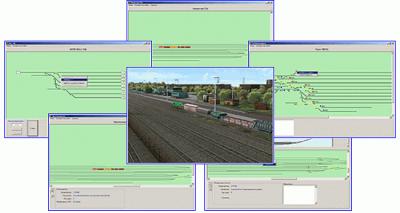
The laboratory complex allows you:
master the business process of the cargo station and local work;
prepare professionals of a new formation;
have ideas, knowledge and skills to design multimedia applications and virtual reality applications;
design of software and hardware that simulate the real interaction of technological and work processes;
modeling behavior of complex objects, etc.
Modeling of transport systems of cities and regions of Russia
The complex methods used for modeling transport systems of cities and regions of Russia allow to conclude that the adequacy of the model and the correctness of the obtained result in the redistribution of transport depends on the correct formation of the transport proposal in the construction of transport models.
In addition to educational and scientific activities, the Information Technologies in Business Faculty has the opportunity to realize the creative potential of the student. The field of arts and sports very wild.
You can be proud of your faculty, your choice!
Our strategic partner
• Microsoft
• Visual Paradigm
• Software
• SoftLab-NSK
• The administration of the NSO
• The Novosibirsk city Council
• The holding company Russian Railways
Directions of preparation at Information Technologies in Business Faculty
Bachelor Degree
09.03.02-Information systems and technologies
profile of "the Intelligent transport system»
The form and terms of education: full-time, 4 years
The objects of professional activity of bachelors are information systems and networks, their mathematical, information and software, methods and methods of design, debugging, production and operation of software information systems in the field of management of technological business processes in transport.
09.03.03 – Applied computer science
profile " Corporate information systems in transport»
The form and terms of education: full-time, 4 years.
The objects of professional activity of bachelors are: information systems, their creation, implementation, analysis and support, as well as their direct use to solve functional problems of information, material and financial flows management.
38.03.02-Management
profile " logistics and supply chain management»
The form and terms of education: full-time, 4 years, part-time 5 years.
Graduates in the specialization "logistics and supply chain management" receive the qualification of "bachelor" can occupy the position of managers, logisticians, consultants, analysts, head of departments of logistics and their separate divisions, to carry out the management of individual logistics projects in various sectors of the economy.
The training program of the direction "logistics" includes all aspects of logistics management: from elementary logistics operations to design and strategic management of supply chains. The program fully complies with international standards (European Logistics Association – ELA).
Teaching and laboratory facilities Shops - Faculty of Business Informatici
• Laboratory "System analysis and management of transport facilities", AUD. 223a, established in 2008.
• Laboratory "Modeling of business processes in transport", AUD. 461, established in 2007.
• Laboratory of Telecommunications and network administration, AUD. 457, established in 2007.
• Lab, "Geoinformatics, 3D and simulator technologies", RM. 453, established in 2007.
• Laboratory "information systems Design", AUD. 451, established in 2007.
• Laboratory of "System analysis of transport logistics complexes", AUD. 443, established in 2016.
• Laboratory of "artificial intelligence Systems", AUD. 450, established in 2016.
• •Student design Bureau. Server FBI, RM. 466, established in 2007.
• Computer class of the FBI, RM. 445, created in 2007.
• Computer class of the FBI, RM. 447, established in 2007.
• Computer class of the FBI, RM. 454, established in 2007.
• Computer class of the FBI, RM. 460, established in 2007.
• Computer class of the FBI, RM. 314, established in 2013.